
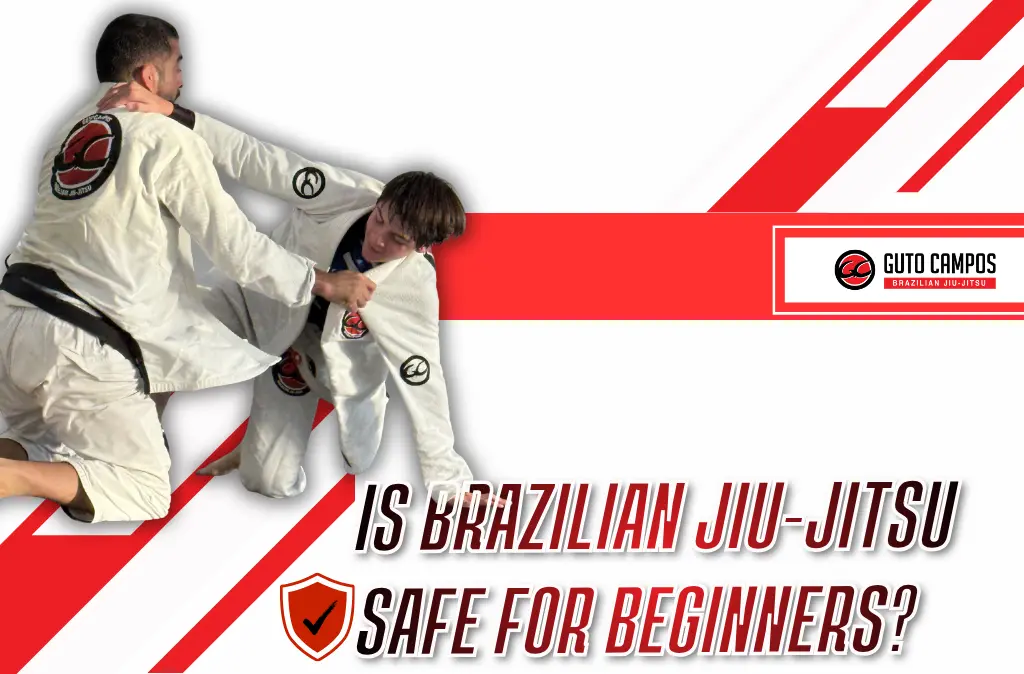
Is Brazilian Jiu-Jitsu Safe for Beginners?
When people think about starting Brazilian Jiu-Jitsu, the first question is often:
Is BJJ even made for beginners?
Many assume Jiu-Jitsu is only for athletes, competitors, or people who already know how to fight. They picture advanced students moving fast, sparring hard, and speaking a language they don’t understand.
It’s easy to wonder:
Will I fit in?
Will I be expected to keep up right away?
Is there actually a place for someone with zero experience?
These are valid questions.
The truth is, Brazilian Jiu-Jitsu is built on progression. Every black belt once started with no experience at all. In a properly structured academy, beginners are not thrown into chaos. They are guided step by step.
To understand whether BJJ is safe for beginners, it helps to understand how the art is designed and how classes are structured from day one.
Built-In Safety Mechanisms in Brazilian Jiu-Jitsu
Brazilian Jiu-Jitsu includes several structural systems that exist specifically to protect training partners.
1. The Tap-Out System
The most important safety system in Brazilian Jiu-Jitsu is the tap.
When a submission such as a joint lock or choke is applied, the person caught in the position taps their training partner clearly and firmly. Tapping your partner ensures they feel it right away.
The moment someone taps, everything stops.
There is no pushing through it. There is no finishing the move. Training partners are expected to release immediately.
Beginners are taught from day one to tap early rather than wait until something hurts. Tapping is not seen as losing. It is how you train safely and consistently.
This system keeps control in the hands of both people and creates shared responsibility on the mat.
Unlike striking-based sports, where impact can happen before you react, Jiu-Jitsu allows you to signal when you’ve reached your limit.
2. No Striking in BJJ Training
Brazilian Jiu-Jitsu is a grappling art.
There are no punches, no kicks, and no head strikes, not for beginners and not for advanced students. Training focuses entirely on control, positioning, and submissions.
Because there is no striking, students are not dealing with impact to the head or body during regular training. The goal is to apply technique with control, not force.
Instead of trading blows, partners work to gain position, escape safely, and apply submissions with precision.
This makes the training environment very different from boxing, kickboxing, or MMA. The emphasis in Jiu-Jitsu is leverage and timing, not impact.
3. Controlled Sparring
Live training, known as rolling, is often misunderstood. It is not a fight simulation. It is structured resistance training.
In a well-run academy, sparring is supervised and structured. Beginners are paired thoughtfully, often starting with positional drills before full rounds. The goal is not to “win” exchanges but to apply technique under control.
Beginners are often guided to:
- Focus on maintaining position
- Learn defensive awareness
- Avoid aggressive submission attempts
- Build endurance gradually
This controlled approach aligns with general exercise safety principles recommended by the American College of Sports Medicine, which emphasizes supervised progression and skill development in new physical activities.
How Beginner Classes Are Structured
Safety in Brazilian Jiu-Jitsu is not accidental. It is built into how classes are organized, how intensity is managed, and how students progress over time.
For beginners, structure matters more than intensity.
A properly designed class follows a progression that is expected to reduce uncertainty and encourages gradual adaptation.
Class Format and Supervised Progression
A typical beginner class is structured to move from preparation to controlled resistance in stages.
| Phase | Purpose | How It Supports Safety |
|---|---|---|
| Warm-Up Drills | Prepare joints, muscles, and cardiovascular system | Reduces strain and prepares the body for movement |
| Step-by-Step Instruction | Break down techniques into manageable parts | Minimizes confusion and unsafe improvisation |
| Cooperative Drilling | Practice movements with controlled resistance | Builds coordination before adding intensity |
| Guided or Optional Sparring | Apply techniques under supervision | Ensures intensity is monitored and scaled |
This progression reflects principles outlined by the American College of Sports Medicine, which emphasizes supervised skill acquisition and gradual overload when starting new physical activities.
Beginners are not expected to “figure it out” through chaotic sparring. Repetition and structure reduce risk and improve control.
At structured academies such as Guto Campos BJJ, beginners are introduced to movement patterns gradually rather than through training without guidance.
Intensity Is Adjustable, Not Fixed
One of the most common misconceptions is that every BJJ session is maximum effort.
In reality, intensity in Brazilian Jiu-Jitsu is highly adjustable.
Beginners can:
- Ask training partners to reduce pace or resistance
- Sit out rounds without pressure
- Focus on positional sparring rather than full rolling
- Train at a slower speed while learning mechanics
Many studies define moderate versus vigorous activity based on heart rate percentage. While BJJ can reach vigorous levels, not every exchange needs to operate at maximum intensity.
Technique is prioritized over force.
That scalability makes the art accessible to adults who may be returning to physical activity after time away.
Adaptation Happens Gradually
Another concern beginners often have is whether their body can handle grappling.
Early sessions may feel demanding, especially when learning new movement patterns involving hip rotation, core stabilization, and shoulder control.
However, exercise adaptation follows familiar physiological principles.
According to medical sources, the body adapts to physical stress through gradual increase in effort. When load increases gradually, connective tissue, muscle strength, and cardiovascular capacity improve over time.
Beginner BJJ classes naturally follow this model:
- Drilling precedes sparring
- Intensity increases gradually
- Conditioning improves through repetition
- Volume builds over weeks, not days
Elite fitness is not required. Fitness develops through consistent participation.
Shared Responsibility and Training Culture
Safety in Jiu-Jitsu is also cultural. Unlike individual gym workouts, BJJ is partner-based. Each participant shares responsibility for maintaining control.
Key training principles include:
- Immediate release upon tap
- Controlled application of submissions
- Avoiding sudden or reckless movements
- Respecting differences in experience and size
In structured academies, like Guto Campos BJJ, instructors actively supervise and correct unsafe behavior. The emphasis remains on technical efficiency rather than aggression.
Safety in Jiu-Jitsu is also cultural. Students are expected to train with control, respect their partners, and release immediately when someone taps. Instructors actively correct unsafe behavior to maintain a safe environment.
When Beginners Should Take Extra Care
While Brazilian Jiu-Jitsu is structured for safety, responsible participation still matters.
Beginners should:
- Communicate prior injuries to instructors
- Ease into BJJ training frequency
- Focus on fundamentals rather than winning exchanges
- Prioritize tapping early rather than resisting too long
These are not warnings against the art. They are common-sense principles that apply to any new physical activity.
So, Is Brazilian Jiu-Jitsu Safe for Beginners?
Yes! When taught in a structured, instructor-led environment, Brazilian Jiu-Jitsu includes built-in safety systems that allow beginners to train progressively.
The tap-out system provides immediate control.
Class structure reduces chaos.
Intensity can be scaled.
Instruction reinforces responsible behavior.
Like any physical activity, it requires attention and consistency. But it is not reckless, uncontrolled, or inherently unsafe for beginners.
For adults considering starting BJJ, the most important variable is the training environment.
If you want to experience how beginner-friendly structured grappling feels, Guto Campos BJJ offers a free 3-day trial for new students.
No long-term commitment, but real BJJ training for everyone else and beginners. Just a chance to see how it actually works on the mat.

